

Where Do Summer Blooms Go When the Season Ends?
People would answer the question the same way.
They fade.
The petals soften. The stems bend. The vase is emptied, washed, and returned to the shelf until another bouquet takes its place.
Flowers, we are told, teach us how to accept impermanence.
It is a beautiful idea.
But history suggests that humanity has spent thousands of years doing precisely the opposite.
For something we claim to love because it disappears, we have devoted remarkable effort trying to make it stay.
People paint flowers.
We press them between the pages of books.
We embroider them onto silk, carve them into stone, cast them in bronze, and preserve them inside porcelain.
Perhaps the relationship between flowers and time has always been more complicated than we admit.
Perhaps we do not love flowers because they fade.
Perhaps we simply inherited the belief that beautiful things are supposed to.
The strange bouquet that never existed
One of the most curious traditions in European painting is the seventeenth-century Dutch still life.
At first glance, the bouquets appear astonishingly realistic. Every petal is observed with scientific precision, every leaf rendered with impossible patience.
But look closer.
The bouquets themselves could never exist.
Tulips bloom in one season, peonies in another, irises in another still. No gardener could gather them together on the same morning.
Yet painters did exactly that.
They were never documenting a garden.
They were editing time.
A Dutch still life is less a study of flowers than an argument with the calendar. It quietly insists that what nature separates, memory may reunite.
Long before photography or digital archives, artists were already asking a question that feels surprisingly contemporary:
Must beauty obey the seasons?

Ambrosius Bosschaert, Still-Life of Flowers, 1614, Wikimedia Commons
Yet another tradition would disagree
There is another way of thinking.
It does not attempt to preserve the blossom.
Instead, it pays attention to the moment before it falls.
Its sadness does not come from loss alone, but from the realization that this exact afternoon, this exact breeze, this exact person standing beside us will never assemble themselves in precisely the same way again.
What disappears is not simply the flower.
It is the unrepeatable arrangement of life around it.
One tradition answers impermanence by preserving.
The other answers by accepting.
Perhaps human beings have always lived somewhere between these two instincts—wanting to let things go while quietly hoping they might remain.
Maybe we are remembering the wrong thing
The ancient Greeks distinguished between two kinds of time.
Chronos is measurable time: calendars, clocks, seasons, anniversaries.
Kairos is experienced time: the moment that cannot be scheduled yet somehow defines an entire year.
We often say we miss summer.
But do we?
Few people miss July itself.
We miss coffee on a balcony before the city wakes; the jasmine drifting through an open window the bare feet on warm stone; a hand brushing against lavender; a conversation that lasted longer than the light.
So summer is not a season.
It is a collection of moments that happened to occur while the world was warm.
Perhaps that is why memory almost never returns chronologically.
It returns atmospherically.
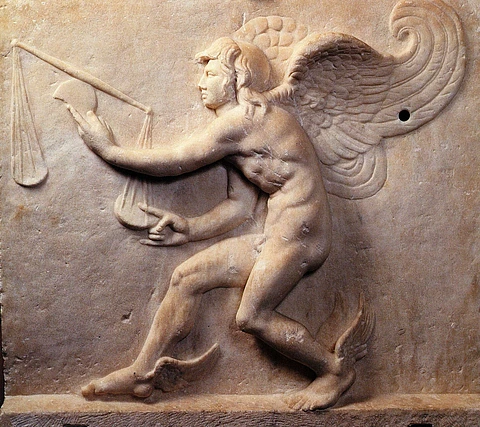
Unknown, Kairos Relief (Lysippus tradition), 2nd c. BC, Turin Museo di Arte Greco-Romana
Marcel Proust understood this better than anyone
In In Search of Lost Time, memory does not arrive because the narrator decides to remember.
It arrives because a small sensation—a taste, a texture, an ordinary object—unexpectedly unlocks an entire world.
Memory is not searched for.
It is triggered.
A fragrance can accomplish what intention cannot.
So can afternoon light falling across a table.
Perhaps flowers work the same way.
We rarely stop before them because they are botanical specimens. We stop because they awaken something larger than themselves.
They remind us of another room.
Another summer.
Another version of ourselves.
The flower is only the messenger.
“But when from a long-distant past nothing subsists, after the people are dead, after the things are broken and scattered, taste and smell alone, more fragile but more enduring, more immaterial, more persistent, more faithful, remain poised a long time, like souls, remembering, waiting, hoping, amid the ruins of all the rest; and bear unflinchingly, in the tiny and almost impalpable drop of their essence, the vast structure of recollection.”
Marcel Proust, In Search of Lost Time, Vol. 1, Modern Library, 1981
Then what does a home actually keep?
The philosopher Gaston Bachelard suggested that a house is more than shelter.
It is where imagination settles.
Corners, windows, staircases, drawers—these ordinary places gradually absorb the lives lived around them until architecture becomes memory.
Perhaps that is why the objects inside a home matter so much.
A chair remembers the person who always sat there; a cup remembers the hand that reaches for it every morning; a vase remembers the light.
Objects do not merely occupy space.
They accumulate meaning.
Yet there is another tradition, one that asks even more of the objects we live with.
Across much of East Asia, flowers and symbols have long carried wishes alongside memories.
A butterfly is not only admired for its wings; it speaks quietly of transformation.
A peach is not merely fruit; it becomes a wish for longevity.
A lotus is not only a flower; it suggests purity rising through difficulty.
The object does not simply say,
"This once happened."
It also says,
"May this continue."
Memory looks backward.
Blessing looks forward.
The home has always made room for both.
Perhaps this is where livarié flower begins
At livarié flower, they do not see flowers merely as decoration.
Nor do they think permanence is superior to impermanence.
Fresh flowers belong to nature.
Their beauty lies partly in their passing.
Their work belongs to another tradition—the human desire to let meaningful moments accompany everyday life a little longer.
The 3D printed floral stems and sculptural vases are not intended to replace the garden outside the window.
They are designed to continue its conversation indoors.
Through digital modeling and resin craftsmanship, botanical forms become objects that exist somewhere between sculpture and memory, between observation and imagination.
A single stem beside a bedside table.
Three branches catching the morning light.
A vessel waiting quietly through changing seasons.
These are not attempts to stop time.
Nothing can.
They are invitations to notice it.

Where do summer blooms go when the season ends?
Perhaps they do not disappear.
Perhaps they move—from the garden into memory, from memory into objects, and from objects into the quiet rituals of daily life.
We often think we bring flowers into our homes because they are beautiful.
Perhaps we bring them inside for another reason.
Because they carry two kinds of time.
One belongs to memory.
The other belongs to hope.
And perhaps that is what the best objects have always done.
They remind us of what was beautiful, while gently expressing a wish for what is still to come.
When the season ends, the garden changes.
But sometimes, in the morning light falling across a table, beauty simply learns another way to stay.