
When Does Symbolic Jewelry Start to Feel Truly Wearable?
More Than Ornament
Symbolic jewelry often carries something larger than ornament. It may draw from a cultural code, a religious form, a ritual association, or a private belief that asks to be made visible. Love, protection, continuity, and memory all belong to that field, but they are only part of it. Some of the most visually complex pieces in jewelry history became complex for a reason: they were trying to give form to something that was never meant to stay abstract. They were asked to show what they stood for.
That does not make them excessive, nor does it make them unsuccessful. In many cases, the density of reference is exactly where their force comes from. A ceremonial object, a court jewel, or a devotional ornament does not need to become universally wearable in order to matter. It can be highly specific, highly coded, even resistant to ordinary use, and still possess extraordinary value. A narrower question appears only when symbolically charged forms enter a more open and repeatable field of dress. At that point, a different set of design questions begins.
Form Before Explanation
This is why it helps to begin not with symbolism alone, but with form. Charlotte Chesnais has described jewelry not simply as earrings, rings, bracelets, or necklaces, but as “beautiful objects,” and as a medium for an ongoing research into form and use. Even the early multi-cuff associated with the beginning of her design language was conceived to be stacked. That detail matters because it suggests something more rigorous than styling. Wearability is not added after the fact. It is already present at the level of conception. Source
That standard is useful here not because every symbolic object ought to submit to ordinary wear, and not because cultural or emotional depth weakens design. Often the opposite is true. Some objects become more powerful precisely because they refuse simplification. But once jewelry is asked to circulate through contemporary dress—through repetition, layering, movement across settings, and use outside a single ceremonial or interpretive frame—it faces an additional problem. Not whether its meaning is valid, but how that meaning is held by form.
Some pieces choose specificity over adaptability, and that is a legitimate choice. Others move in the opposite direction. They try to remain legible while entering a more flexible structure of wear. That second path does not replace symbolic density. It simply asks what happens when symbols are designed to move.
From Motif to Language
This is where many symbolically charged designs become difficult. In order to remain recognisable, they often preserve too much of the original image. A knot must still look unmistakably like a knot. A talismanic shape must still appear visibly protective. A sacred or inherited sign must still retain enough of its original profile to be immediately legible. None of that is a flaw in itself. But it does create a tension. The more a motif has to keep explaining its origin, the harder it becomes for it to participate in a more open and repeatable grammar of dress.
Design becomes more adaptable when it allows a motif to change register. A form can keep its source without carrying the full burden of literal explanation every time it appears. That usually happens through reduction, abstraction, or redistribution. The motif stops behaving like a single complete image and starts behaving more like a contour, a rhythm, a proportion, or a way of connecting parts. At that point, it has a better chance of entering repeat wear without giving up its origin entirely.
How Motifs Keep Moving
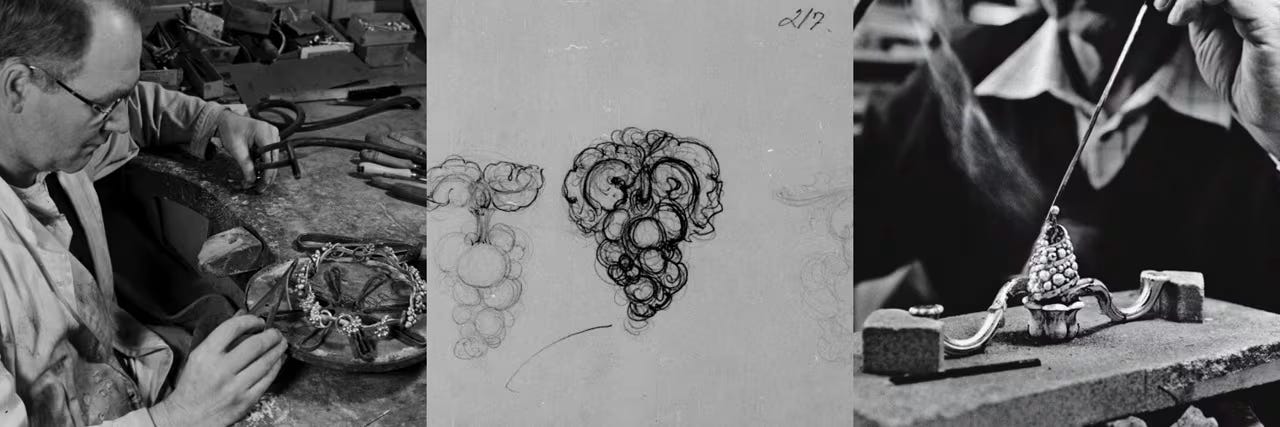
The Moonlight Grapes collection is useful here because it demonstrates a particular kind of transformation. Georg Jensen describes the collection as growing out of grape-shaped ornaments found on early silver hollowware, then evolving into contemporary jewelry while continuing to reinterpret the beaded motif in new and more abstract ways. That is a helpful model because it does not depend on literal revival. The original reference remains visible, but it is allowed to shift in scale, intensity, and composition.
This kind of evolution matters because it suggests a way for symbols to remain active without staying fixed. The grape motif is not preserved as a closed quotation. It becomes a language that can appear softly or emphatically, across different kinds of pieces, while still carrying a traceable origin. What survives is not the entire ornamental image, but a set of formal cues capable of being reworked over time.
A Structure for Symbols
This is where Aesth & Util becomes more interesting than a simple reading of symbolism would suggest. The brand frames itself through long-termism and “practical aesthetics,” describing objects as vessels for philosophy and purpose rather than mere accessories. On its own, that language could remain abstract. What gives it more design weight is that it does not stop at symbolic reference. It places symbolic forms inside a modular structure of wear.
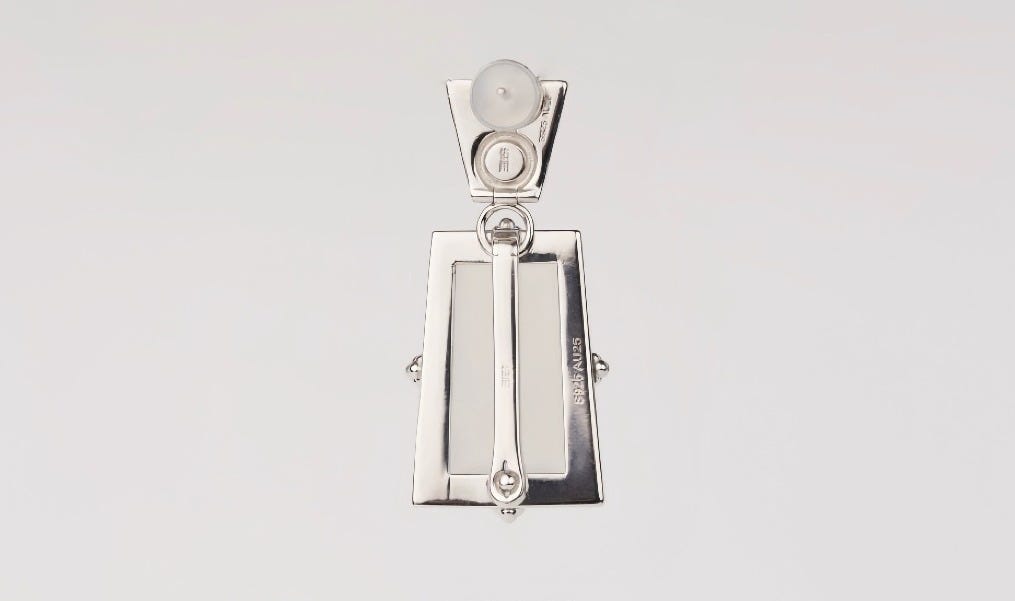
The brand interview makes this clearer. The system is described through hidden clasps that allow pendants to snap onto studs, hoops, or chains. That is a small technical detail with larger implications. It means a symbolic form is not being treated as a self-contained emblem. It is being asked to enter an existing framework of dress. In other words, it must do more than signify. It must also remain structurally compatible with other modes of wear.
That is the point at which the brand’s proposition becomes worth discussing. The issue is not that symbolism has been made more useful, as if usefulness were inherently superior. The issue is that a symbolically charged form is being redesigned for a different life on the body—one that includes reattachment, layering, variation, and recurrence.
Symbols in Motion
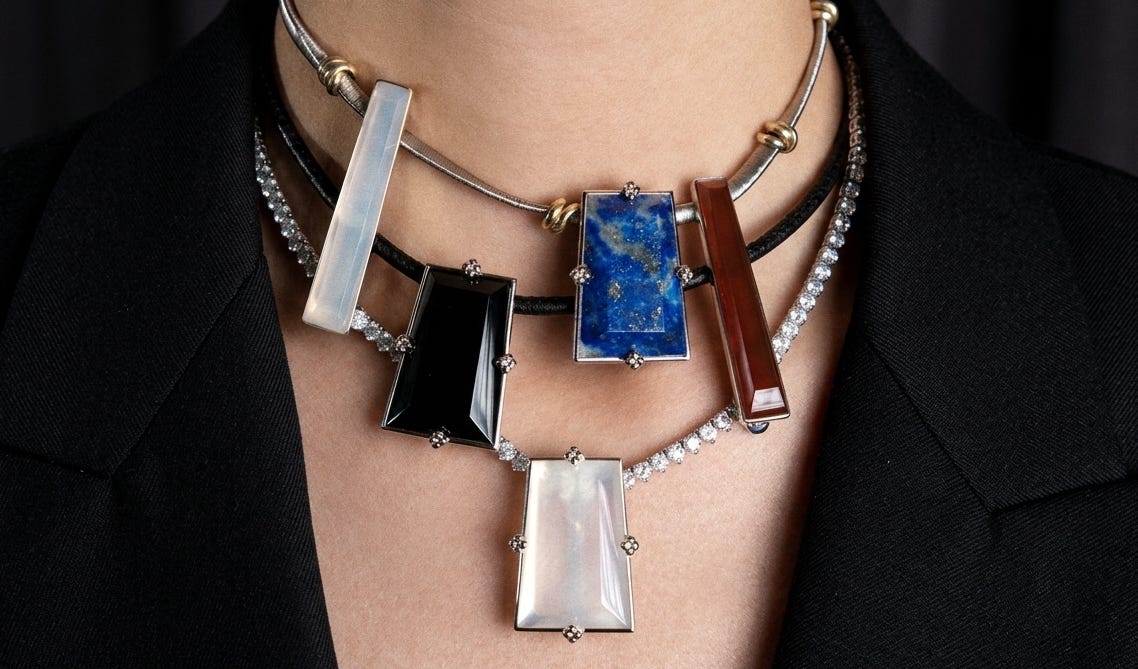
That pressure becomes more visible when the brand’s series logic is considered structurally rather than illustratively. The Anyu Collection is described through a trapezoidal form drawn from Tibetan architecture, especially the wide-based structural logic associated with resilience, steadiness, and protection. What matters here is not only that the form symbolizes grounding. The more specific design question is how such a form can be translated into jewelry without becoming visually immobile. In a modular system, it has to do more than stand for protection. It has to remain compatible with different scales, attachments, and uses.
This is where the brand’s approach becomes genuinely specific. Modularity alone is not unusual. Symbolism alone is not unusual either. What is more demanding is asking symbolic forms to remain open—open to variation, open to repetition, and open to being worn in more than one register—without reducing them to generic adaptability. The challenge is not to remove meaning, but to keep meaning structurally alive while the form moves.
A Different Direction
None of this suggests that symbolic jewelry should become lighter, simpler, or more universal in order to be successful. A highly specific object may retain far more force than a broadly wearable one. A ceremonial jewel, a sacred ornament, or an inherited form can remain powerful precisely because it resists adaptation. The issue is not hierarchy. It is direction.
One direction preserves symbolic intensity through specificity. Another explores what happens when that intensity is translated into a more flexible and repeatable system of wear. Contemporary jewelry increasingly contains both. The second path simply asks a newer design question: not whether a form can signify, but whether it can continue to function while moving between contexts, attachments, and uses.
That is what makes this development worth paying attention to. A symbol does not lose seriousness when it becomes structurally articulate. It simply enters a different design condition. It has to negotiate with repetition, with compatibility, and with the ordinary complexity of being worn again and again. When that negotiation succeeds, the result is not a weaker symbol. It is a symbol that has learned how to live differently.